Filter by topic and date
YANG Quick Status Update Before this IETF 97
- Benoît Claise Operations and Management Area Director
13 Nov 2016
Let me start with some good news. Not only we recently approved RESTCONF (right now in the RFC editor queue), but we published the IPv4 and IPv6 base routing models in RFC 8022.
We all learned a lot during the long process of specifying those routing YANG models and understand many things way better now. RFC 8022 is central for standardizing many other routing YANG models, as you can see from this picture from the brand new visual dependency tool developed by Joe Clarke this week-end during the IETF Hackathon.
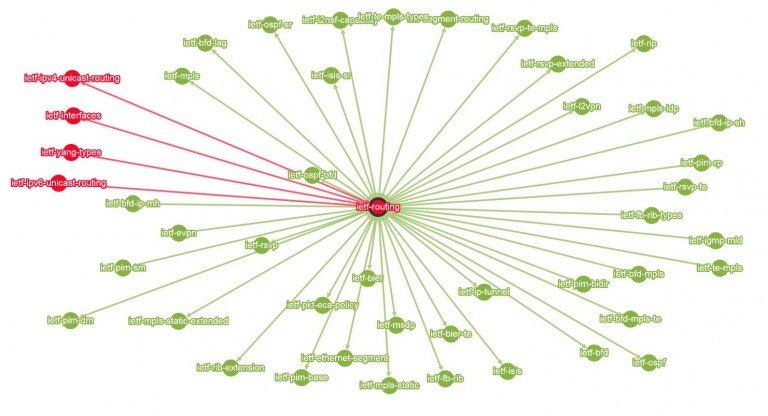
If you are excited to explore YANG models dependencies using this tool, give it a try with the YANG modules you’re most impatient to see done.
So what are the hot topics for this IETF 97? We continue to add flexibility to support finalization of modeling work.
First the schema mount draft, which specifies a mechanism to combine YANG modules into the schema defined in other YANG modules, is an essential building block that should be standardized soon. Many YANG modules depend on this schema mount solution.
Second, the Revised Conceptual Model for YANG Datastores draft will receive a lot of attention during this week. It focuses on a revised conceptual model of datastores based on the experience gained with the current model and addresses requirements that were not well supported in the initial model. Basically, it introduces new datastores, for accessing additional views of the intended configuration, and a new ability to obtain the operational state.
Third, focusing on finishing up key YANG models, such as key chain, key store, topologies, key routing ones (OSPF, ISIS, PIM, BGP), access-list, logical network elements, etc. The routing base models follow the config and config-state branch conventions for specifying, respectively the configuration and operational data. Models being submitted for publication request should follow this same convention. We know that operators are moving to data modeling-driven management, and waiting for standard models.
As mentioned during the last IETF meeting in Berlin, it’s important to publish the IETF YANG models within a reasonable time frame, if the IETF wants to play a key role in specifying YANG models, as opposed to only standardizing the protocols (NETCONF/RESTCONF and related push mechanisms) and related encodings (JSON, XML). As I mentioned in Berlin 3 months, we have maximum a year to publish the majority of those IETF YANG models. It’s time to focus and deliver.
More on the Hackathon outcomes later after the IETF, but I can already tell that this Hackathon brought new tools and implementations. This is essential as your automation is as good as your tools chain.
After the IETF 97, I plan on updating this blog with the latest achievements.
Regards, Benoit (OPS Area Director)